Cepel – Electrical Energy Research Center
+55 21 2666 6273 +55 21 2667 3079 cepel@cepel.br Visit website
Avenida Olinda, 5800 – Adrianópolis
Nova Iguaçu, RJ, 21053-060
Brazil
Overview
High Voltage & High Power LAB.
Avenida Olinda, 5800 – Adrianópolis, Nova Iguaçu, RJ, 21053-060
BRAZIL
Material & Mechatronic Lab Energy Efficiency Lab.
Avenida Horácio Macedo, 354 – Cidade Universitária, Rio de Janeiro, RJ, 21941-911
BRAZIL
Key Contact:
Cepel Business and Laboratory Division
E-mail Address: secretaria.integrada@cepel.br
Phone: + 55 21 25986070, +55 21 2598-6472
Mailing Address:
Caixa Postal 68007, Cidade Universitária, Rio de Janeiro, RJ,
ZIP CODE: 21944-970
BRAZIL
Year Founded 1974
Material Lab: 1978
HV & HP LAB.: 1980
Total Number of Employees: 55
Major Export Markets Served: Electric Utilities and HV Equipment Suppliers
Services
High Voltage Laboratory
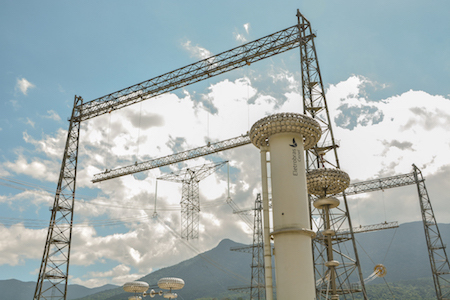
Main Test Hall: 44 x 30 x 27 m (LWH)
Outdoor Test Area 41,000 m², test arrangements up to 70 meters in height
Dielectric Testing Facilities
| Impulse Testing | Max. Volt./Current Indoor Test Hall |
Max. Volt./Current Outdoor Test Area (*) |
Standard/Remarks |
| Lightning Impulse | 3.2 MV | 6.0 MV | IEC, ANSI, ABNT |
| Switching Impulse | 2.8 MV | +2.5 MV -4.5 MV |
IEC, ANSI, ABNT |
| AC Stress: (Dry/Wet) | 1.1 MV / 2.0 A | 1.2 kV / 1.0 A | IEC, ANSI, ABNT |
| DC Stress: (Dry/Wet) | ±1.0 MV / 2.0 A | ±1.0 kV / 50 mA (Bipolar) ±1.6 kV / 50 mA (Single-pole) |
IEC, ANSI, ABNT |
| PD & RIV Testing: | 1.1 MV / 2.0 A | – | IEC, ANSI, ABNT |
| C & Tan ∂ | 1.1 kV / 2.0 A | – | IEC, ANSI, ABNT |
(*) Ultra-High Voltage Laboratory: Three single-phase 750 kV, 60 Hz, Voltage transformers for three-phase tests. 6.4 MV/640 kJ impulse generator.
Pollution Testing
Test Chamber: 18 x 16 x 20 m (LWH)
| Standard | Max.A.C. Volt | Max.D.C. Volt | |
| Salt Fog | IEC/ANSI/ABNT | 600 kV / 2A | ±600 kV |
| Clean Fog | IEC/ANSI/ABNT | 600 kV / 2A | ±600 kV |
Pollution Testing
Dimensions of Main Test Chamber: 18 x 16 x 20 m (LWH)
| Standard | Max.A.C. Volt | Max.D.C. Volt | |
| Salt Fog | IEC/ANSI/ABNT | 600 kV / 2A | ±600 kV |
| Clean Fog | IEC/ANSI/ABNT | 600 kV / 2A | ±600 kV |
Other Tests:
Puncture test on insulators; voltage distribution on insulator strings; visual and UV corona; bias test on HV disconnectors and circuit breakers; thermal stability on capacitors; fast chopped impulse testing on SF6, OIP and RIP bushings; Measurements, monitoring and diagnostics of substation and transmission line equipment.
High Power Laboratory
Power Source: Three single-phase power transformers 138 kV /(4,122-33,482) V in 26 steps, rated 11 MVA (continuously) and 350 MVA (1.0 s)
Specifications of the Main Test Bay
• Power Frequency: 60 Hz
• Max. MVA: 1,050 (Installed Capacity)
• Max. kV: 100 kV (single-phase) or 60 kV (three-phase)
• Max. kA & Duration: 100 kA (0.2 seconds) or 40 kA (2 seconds)
High Current Test Facilities & Capabilities: 21 MVA (continuously), 120 MVA (5.0 s).
Three single-phase power transformers 138 kV / 4.16 kV ±20%
Three single-phase power transformers bank 4.16 kV / 110-4,122 V
Main Power Tests:
• (i) Making and breaking of short-circuit current on circuit breakers, expulsion and current limiting fuses, automatic circuit reclosers, earthing switches, high voltage contactors and other equipment, in the range of 4.5 kV to 100 kV (single-phase) or 4.5 kV to 60 kV (three-phase) with power up to 750 MVA.
• (ii) Power arc tests on insulator strings for transmission lines; internal arc tests on metal enclosed switchgear and control gear; pressure relief tests on surge arresters.
• (iii) Short circuit tests on distribution and power transformers and potential transformers.
• (iv) Short time withstand current tests on reactors, current transformers, metal enclosed switchgear and control gear, ducts, cables, transmission line space-dumpers and other equipment.
Heat Run Tests:
Temperature rise tests on switchgear and control gear assemblies, ducts, disconnectors, or any other low and high voltage equipment, test current up to 50 kA continuously.
Other High-Power Tests
Making and breaking of short circuit current on breakers, fuses, switches, contactors and other equipment, in the range of 110 V to 3500 V (3-phase) or 110 V to 6000 V (1-phase) with power up to 120 MVA; short-time withstand current on current transformers, reactors, switchgear and control gear assemblies, disconnectors and earthing switches, cables and other equipment; maximum current of 230 kA; Lightning DC current effects on optical ground wires (OPGW).
Other Testing Facilities
Environmental Tests: Chamber tests: Salt spray, wet and SO2, UV Fluorescent Test.
High Voltage Calibration: Accredited Laboratory for calibrating High Voltage measuring systems up to 2,5 MV for AC, DC and Voltage and Current Impulses. Calibration is performed according to IEC 60060-2 and IEC 61083.
Smart Grid Laboratory: Facility for experimental research and testing of quasi-stationary and dynamic characteristics of the interface between DER (Distributed Energy Resources) and the power grid. It comprises photovoltaic (PV) systems, storage systems with batteries, highly dynamic AC and DC programable power sources, real-time digital simulators, smart power inverters, on-line programable loads, multi-tap transformers, wind turbine emulators and communication/ measurement/ control systems. It is divided in three applications areas:
• Power hardware-in-the-loop test bench
• Low voltage (LV) microgrid
• Component testing (power devices, communication devices)
Material and Mechatronic Laboratory:
Dedicated to materials research at Cepel, the multidisciplinary areas of the Material and Mechatronic Laboratory carry out a wide variety of laboratory tests, technological services, and experimental research to meet the needs of important enterprises in the energy sector. With a team of specialists and an infrastructure of modern equipment, the Laboratory investigates different types of materials and their performance – polymers, metals and their alloys, ceramics, coatings, among others.
Metallography: Equipped with modern materials characterization apparatus (metallic and non-metallic), and mechanical properties tests, the area develops projects related to structural integrity and improvement of the properties of components used in equipment of the electrical sector, seeking a safer, economical operation associated with greater availability for generation.
Corrosion: The resistance of materials to different weathering agents is evaluated by accelerated and non-accelerated corrosion tests, in laboratory installation as well as in field condition. The area investigates corrosion processes and develops experimental research on anticorrosive methods, coatings technology and optimized solutions regarding cost and anticorrosive performance, to improve long-term life of equipment and metallic structures of the energy sector.
Chemical Analysis: The area develops methodologies and performs chemical analyzes according to national or international standards, covering a wide range of materials for power generation, transmission and distribution. Results of chemical analysis determine materials’ composition and allow its characterization. They are important tools to the investigation of different kinds of materials failures and to monitor and improve equipment´s performance. One of the projects in the area is related to proactive maintenance for the energy sector based on lubricating oil monitoring
Mechatronics and Structural Dynamics:Evaluation of damage and fatigue in wind turbine blades, analysis of mechanical efforts by finite elements, investigation of deformation and mechanical vibrations in equipment, structures and cables of transmission lines, development of intelligent sensors for instrumentation and monitoring of assets, instrumentation and aerodynamic tests in wind tunnel, design and manufacture of prototypes of mechatronic sensors (housing, electronics and software), training in the area of mechatronics and dynamics of structures.
Quality Management System in Cepel´s laboratories
The operation of all laboratories at the Electric Energy Research Center – Cepel is guided by the ABNT NBR ISO/IEC 17025:2017 Standard – “General Requirements for the Competence of Testing and Calibration Laboratories”. To strengthen such guideline application, Cepel has had a Quality Management System (QMS) in operation for over 20 years. Among the actions to provide technical excellence in laboratory activities, Cepel carries out a program of periodic internal audits through this quality system to assess and promote the compliance of all processes with the requirements of the Standard.
The most important factors to ensure the quality of all services offered by Cepel’s laboratories are qualified, capable and trained teams for the activities they carry out; updated technical and security procedures; installations and equipment with technical resources maintained in the state of the art; calibrated measuring systems and instruments with proven traceability.
The accreditation of laboratories such as Cepel´s in Brazil is granted by the General Accreditation Coordination (Cgcre) of the National Institute of Metrology, Quality, and Technology (Inmetro), following world class regulations established with the technical rigor necessary for such a grant. Based on its effective MQS, Cepel can demonstrate at any time the conditions that characterize the technical excellence of all the laboratory services it performs, whether it is accredited or not.
Considering the wide range of laboratory services offered by Cepel and the costs for formally establishing and maintaining the accreditation by Cgcre, Cepel has taken the decision to be accredited only for services with high market demand or upon specific customer request. However, Cepel is open to discussing and considering the possibility of requesting accreditation from Cgcre/Inmetro upon client request and recognition of being a sustainable business case.